Public Money vs Sharp Money in NBA Betting: Reading the Difference and Knowing Which to Follow
 Available in US
Public vs Sharp Money: Why Knowing the Difference Is More Useful Than Picking Sides
There is a version of NBA betting wisdom that says simply: always follow the sharp money. Another version says: always fade the public. Both of these rules, applied mechanically, lose money over time. What actually works is understanding what each type of market action reveals about the betting landscape for a specific game, then deciding where that leaves the analytical picture you have already formed independently.
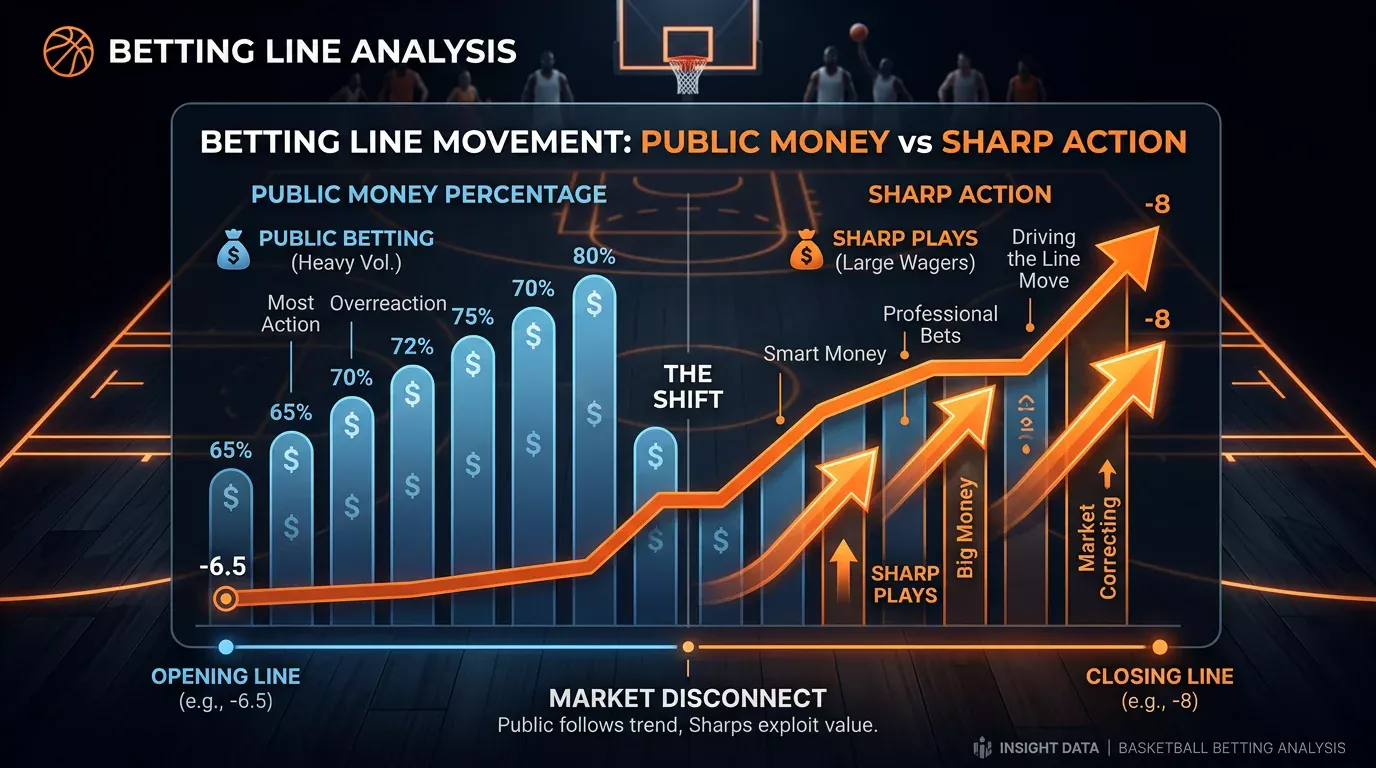
Sharp money, in NBA betting terms, refers to large bets placed by professional or semi-professional bettors — people whose historical track record the bookmaker has identified as worth respecting. When a sharp bettor places a significant bet on one side of a game, the bookmaker moves the line to reduce exposure and to signal that they have received credible information about the game’s probability distribution. Sharp action is slow to materialise and often subtle; the line moves quietly rather than dramatically.
Public money is high volume and low average size — casual bettors placing small to medium stakes, often on recognisable teams, favourites, and high-profile games. Public action moves lines too, because volume accumulates, but the movement does not carry the same informational signal as sharp action. Understanding this distinction — same line movement, completely different informational content — is the foundation of reading the NBA market intelligently.
How to Identify Sharp Action in NBA Spread and Totals Markets
Identifying sharp action from the outside, as a UK retail bettor, requires indirect inference rather than direct observation. You cannot see individual bet sizes on UK bookmaker platforms. What you can observe is the line itself and how it moves relative to where the public money is reportedly going.
The clearest signal of sharp action is reverse line movement — when the spread moves in the opposite direction from the public betting percentage. If 70% of reported bets are on Team A, and the spread on Team A lengthens rather than shortens, that movement has been driven by a smaller number of large, credible bets on Team B overriding the public flow. The market is telling you that someone with a verified track record disagrees with the public consensus, and disagreed strongly enough to move the line despite the volume of money going the other way.
Steam moves — rapid, large line movements that happen within minutes rather than hours — are another sharp indicator. A spread that moves two points in ten minutes without any identifiable injury news has typically received sharp action from a coordinated group of professional bettors acting simultaneously across multiple books. Steam moves are not available to react to in time for most UK retail bettors, but identifying them after the fact confirms that your analysis of a game has or has not been validated by the sharpest money in the market.
The Public Bias Patterns That Create Systematic NBA Betting Value
Public money has consistent, identifiable biases that create exploitable patterns across a season. These are not reliable enough to bet mechanically — the bookmaker knows these biases exist and prices against them — but they are strong enough to function as a supporting filter when your independent analysis points in the same direction.
The primetime favourite bias is the most consistent. High-profile NBA games — nationally televised matchups, marquee rivalries, marquee individual matchups — attract disproportionate public money on the favourite. The public wants to back the star player or the better team in the featured game, and that volume pushes the spread. The bookmaker’s margin is higher on these games because the public’s action is less informed. Backing the underdog in primetime games with genuine analytical reasons is not contrarianism for its own sake — it is exploiting a systematic bias in the public market.
The recency bias is the second consistent public pattern. A team that won its last three games by large margins will attract more public money in its next game regardless of who the opponent is or what the spread is. Public bettors remember the most recent results and weight them heavily; the data suggests that a three-game winning streak has very little predictive value for the next game’s spread outcome once you control for actual quality. The public overweights recent form; the analytical bettor uses the full dataset.
The home favourite bias is smaller but real: the public slightly over-backs home favourites relative to their actual win probability. This creates marginal value on road underdogs in games where the public’s attention is on the home team’s recent strong home record rather than the analytical picture. The UK gambling market’s scale — 13.5 million active accounts, around 290 million online bets per month according to Gambling Commission data — means the cumulative effect of these biases is large enough to produce persistent pricing distortions that the bookmaker does not fully correct.
Building an Independent View Before Checking the Market
The most important discipline in public versus sharp money analysis is sequence: form your own view of the game first, then check the market movement to see what it adds. Reversing that sequence — looking at where the money is going before forming your own view — contaminates the independence of your analysis with information you cannot properly weight.
Your independent view does not need to be complex. A ten-minute pre-game analysis covering net rating matchup, rest differential, referee crew, and the injury report produces a directional view that you can then compare against the closing line direction. If the market has moved in the same direction as your analysis, you have confirmation that your independent reasoning aligns with where informed money went. If the market has moved against your view, you have a signal to re-examine your reasoning — perhaps the sharp money knows something you have missed.
What this process is not is a rigid rule to follow sharp action blindly. Sharps are right more often than the public, but they are not right always. A game with reverse line movement in one direction combined with your independent analysis pointing in the opposite direction is a game to pass on rather than a mechanical bet against your own reasoning. The market signal adds weight to your view when it confirms it; it should prompt re-examination when it contradicts it; but it should not override well-reasoned analysis without a specific identified reason why the market knows something you have missed. The principle of independent analysis before market consultation connects directly to the closing line value framework discussed in the guide on reading NBA line movement.
Can UK retail bettors access public versus sharp money split data for NBA games?
Direct access to bet percentage splits is limited on UK platforms — most bookmakers do not publish this data publicly. Some specialist odds tracking and betting analytics sites report public money percentages for major NBA markets, though the data is typically sourced from US-market sportsbooks rather than UK bookmakers directly. These figures give a directional indication of public flow and can be used alongside UK line movement observations to infer where sharp versus public action has been going.
How reliable is the ‘fade the public’ strategy in NBA betting over a full season?
The fade-the-public strategy applied mechanically — backing the side with less than 50% of public bets regardless of other factors — generates modest positive results in specific contexts over large samples, but the edge is small and inconsistent enough that bookmaker margins erode most of it. The strategy is most effective in high-profile games with heavy favourites that attract disproportionate public support beyond what the spread justifies. As a standalone betting system, it performs weakly. As a filter applied on top of independent analytical reasoning, it adds modest value when the public bias aligns with other reasons to back the underdog.
Written by the editors at nba Bets of the day.