NBA Bankroll Management UK 2026
 Available in US

- NBA Bankroll Management: Sustainable UK Staking Plans
- Defining Your NBA Betting Bankroll: Starting Amounts and Mental Accounts
- Flat Staking: The Most Misunderstood Method in Daily NBA Betting
- Unit-Based Staking: How Professionals Track NBA Bets Without Confusion
- Kelly Criterion for NBA: Useful Concept, Dangerous in Raw Form
- How Many NBA Bets Per Day Is Too Many? A Data-Backed Answer
- Losing Runs in NBA Betting: Statistical Expectations vs Emotional Reality
- Bankroll Management in the UK Context: Tax, Withdrawals, and Bonus Stakes
- Staking and Bankroll Questions From UK NBA Bettors
NBA Bankroll Management: Sustainable UK Staking Plans
Here is a pattern I have seen many times: a bettor spends months developing a systematic NBA analysis process, reading injury reports, tracking ATS records, understanding efficiency metrics, and then loses a month’s profit in a single week by over-staking on a game they were “sure about.” The analysis was sound. The bankroll management was not. The result was the same as if they had never done the analytical work.
Bankroll management is the unsexy half of sports betting, and it is the half that determines whether a positive analytical edge translates into actual profit over time. The connection is mathematical: a positive EV process with poor staking will fail. A positive EV process with appropriate staking will succeed. The analysis builds the edge; the staking plan extracts it without blowing up your account during the inevitable losing runs.
In the UK, roughly 10% of adults participate in online sports betting, according to industry estimates from 2026. The vast majority of that population does not use a structured staking system. They bet amounts that feel appropriate in the moment, typically higher when confident and lower when cautious. That confidence-correlated staking is one of the most reliable ways to amplify losses and dampen wins, because confidence and outcome are only weakly correlated in sports betting. This guide is about building a staking framework that removes that correlation and lets your edge do its work over time.
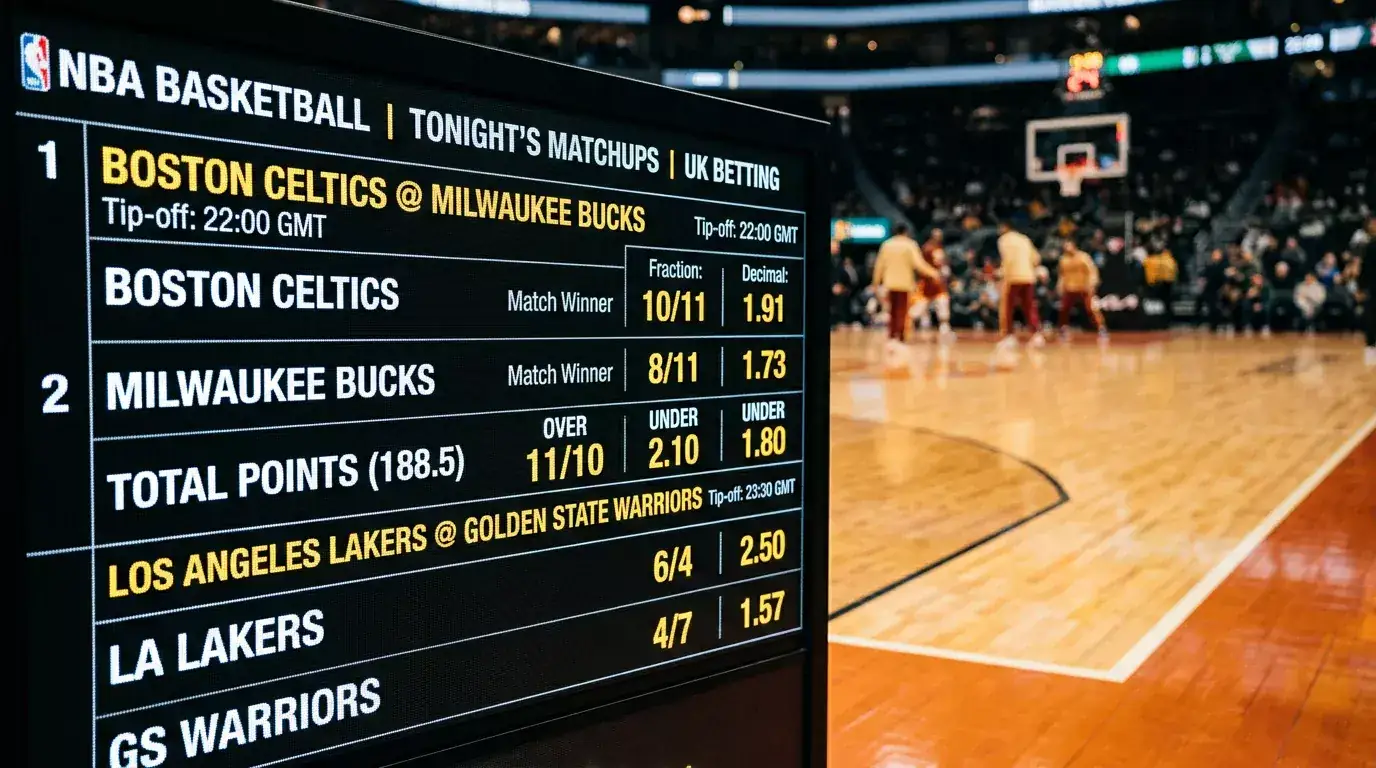
A disciplined staking plan will protect your funds when navigating volatile markets like NBA over/under totals.
Defining Your NBA Betting Bankroll: Starting Amounts and Mental Accounts
A bankroll is the total amount of money you have allocated specifically for betting: money you are genuinely prepared to lose in the worst case, separate from your personal finances, emergency fund, and any other financial obligations. That last part is not a legal disclaimer; it is a practical requirement for bankroll management to function.
The reason separation matters: bankroll management systems set stakes as a percentage of total bankroll. If your “bankroll” is actually your current account balance that you dip into for rent and groceries, the percentage staking calculation becomes meaningless. A £500 bankroll managed as a dedicated betting fund behaves very differently from £500 sitting in an account that also funds your monthly costs.
For UK bettors new to structured bankroll management, the starting amount is less important than the commitment to treating it as a ringfenced fund. You could start with £100 or £1,000, as the principles scale identically. What you cannot do is top up the bankroll impulsively after a losing run, withdraw mid-season from profits “just this once,” or start treating individual bets differently because the balance has moved up or down. The bankroll is an operating fund, not a live score of how your month is going.
One useful mental accounting trick: track your bankroll as a unit count rather than a pound figure. If your starting bankroll is £500 and you decide each unit is £10, you have 50 units. Your results become “+3.2 units” or “-1.7 units” rather than “+£32” or “-£17.” The abstraction from cash figures makes loss runs easier to manage emotionally and makes comparisons across different bankroll sizes straightforward.
Flat Staking: The Most Misunderstood Method in Daily NBA Betting
Flat staking means betting the same amount on every single bet, regardless of how confident you are. One unit per bet, consistently, forever. It sounds almost insultingly simple, which is exactly why most recreational bettors dismiss it in favour of something that feels more sophisticated.
The argument for varying your stake (betting more when confident) seems logical on the surface. If you are genuinely better at predicting outcomes when you feel confident, varying your stake amplifies returns. The problem is that the correlation between confidence and outcome in sports betting is approximately zero for most recreational bettors. The occasions when you feel most certain are often precisely the occasions when you are most influenced by recent positive results, media narrative, or the simple cognitive bias of overconfidence.
The UK market sees around 290 million online sports bets placed per month across all sports, according to industry estimates from 2025. The overwhelming majority of those bets are placed without systematic staking, amounts determined by feel, account balance, or some other non-systematic factor. Flat staking is unusual not because it is less effective, but because it requires a kind of mechanical discipline that conflicts with the natural human instinct to bet more on outcomes you find compelling.
For daily NBA betting specifically, flat staking provides another benefit: it prevents the accumulation of large exposure on any single outcome during a busy betting period. The NBA calendar produces five to ten games per night during peak season. If you scale stakes up based on confidence, a bad night where three or four “high-confidence” bets lose simultaneously creates an outsized loss that flat staking would have automatically capped. The single most costly event in recreational betting history, both personally and across the industry, is the high-confidence multi-game catastrophe. Flat staking makes that event mathematically smaller by construction.
Unit-Based Staking: How Professionals Track NBA Bets Without Confusion
The unit system is a refinement of flat staking that allows for limited variation in stake size while maintaining the core discipline of predefined bet sizing. A standard unit system assigns each bet a rating from 1 to 3 (or 1 to 5 in some systems), where a higher rating reflects greater confidence and correspondingly larger stake.
The critical parameter: the maximum stake in a unit system should be no more than 2% to 3% of your total bankroll. A 1-unit bet might be 1% of bankroll; a 3-unit bet would be 3%. If a single 3-unit bet represents more than 5% of your total funds — the system is miscalibrated and you are vulnerable to a catastrophic losing run.
The advantage of units over pure flat staking is that it allows you to express differential confidence in a structured way. A game where you have high conviction and four independent analytical factors supporting your position is arguably worth more than a game where one factor weakly suggests value. Units give you a vocabulary for that difference without abandoning the discipline of predefined sizing.
Where units go wrong: bettors who rate 80% of their bets as “3 units.” If your distribution of unit ratings is heavily skewed towards the high end, you have essentially abandoned the system and returned to confidence-correlated staking under a different label. A well-calibrated unit system should have most bets at 1 unit, a smaller number at 2, and a rare bet at 3. The scarcity of 3-unit bets is what makes them meaningful when they occur.
Record your unit ratings at the time of bet, before the outcome. The only way to know whether your high-unit bets genuinely perform better than your low-unit bets — and whether the confidence distinction adds value — is to have that record available after a sufficient sample. If your 3-unit bets do not outperform your 1-unit bets over 100+ samples, eliminate the system and return to flat staking.
Kelly Criterion for NBA: Useful Concept, Dangerous in Raw Form
The Kelly Criterion is a mathematical formula that calculates the optimal fraction of bankroll to stake on a bet based on your edge and the odds. The formula is: Kelly fraction = (edge / odds), where edge is your estimated win probability minus the implied probability of the odds, and odds is the decimal odds minus 1.
In theory, Kelly staking maximises the geometric growth rate of your bankroll over time. In practice, it requires an accurate estimate of your true edge, which is not available for most bettors. The formula is brutally sensitive to overestimating edge: if you think you have a 5% edge but your real edge is 2%, Kelly will tell you to bet a fraction that over-stakes relative to your actual advantage and exposes you to larger drawdowns than the system is designed for.
A standard modification used by professional sports bettors is fractional Kelly, typically half Kelly or quarter Kelly. If raw Kelly suggests betting 4% of bankroll, half Kelly suggests 2% and quarter Kelly suggests 1%. The fractional approach sacrifices some theoretical return for substantially reduced variance and protection against the inevitable errors in edge estimation.
My practical recommendation for UK NBA bettors: understand Kelly as a concept for calibrating stake size relative to edge, but do not use it mechanically. The formula’s output depends on your win probability estimate, and that estimate’s accuracy determines whether you are over- or under-staking. Until you have 200+ bets of documented historical data with estimated probabilities versus outcomes, which allows you to measure your calibration — flat staking or a conservative unit system is a safer foundation than Kelly-based sizing.
How Many NBA Bets Per Day Is Too Many? A Data-Backed Answer
The question of daily bet volume is more important than most bettors acknowledge. With 10 to 15 NBA games available on a typical weekday night (15 to 20+ on big weekend slates), the temptation to have action on multiple games simultaneously is constant. The platform experience is designed to facilitate high-volume betting: quick bet slip, easy navigation between games, live betting options that extend the opportunity window.
The relevant data point here comes from betting behaviour research: 76% of online gambling among UK adults aged 18 to 24 occurs on mobile devices, per Gambling Commission figures, and 95% of UK online gambling overall occurs from home. The mobile-home environment removes the friction that might otherwise naturally cap bet volume. There is no physical trip to a betting shop, no queue, no moment of pause. A UK bettor can place 15 NBA bets in 15 minutes from a sofa without any physical or social friction to slow them down.
From a bankroll management perspective, there is a practical limit to how many genuinely analysed bets can be placed in a day before analysis quality degrades. I think about it this way: a bet I spent 15 minutes researching is not the same bet as one I placed in 90 seconds because a game was starting. The former is a considered analytical judgment; the latter is an impulse with a research veneer. Mixing them in the same daily record under the same unit size treats them as equivalent when they are not.
A practical daily cap for most recreational UK NBA bettors is three to five bets on a full slate night, with those bets selected from a shortlist of games that met all of your analytical criteria before you began looking at odds. More than five bets per night, barring exceptional circumstances like a high-information scheduling day, typically indicates that selection standards have dropped to accommodate the desire for more action. Volume is not edge.
Losing Runs in NBA Betting: Statistical Expectations vs Emotional Reality
A bettor who wins 55% of their spread bets, genuine above-average performance, will still experience losing runs of six, eight, or even ten consecutive bets over a season. This is not bad luck or a broken system. It is the statistical expectation of a random variable with a 45% loss rate played over hundreds of trials.
The exact probabilities are instructive. A 55% win rate bettor has a 45% chance of losing any single bet. The probability of losing five consecutive bets is 0.45 to the fifth power, approximately 1.8%. Over a season of 200 bets, that 1.8% probability becomes near-certain to materialise at least once. The probability of a ten-bet losing streak over 200 bets is small but not negligible: roughly 3% per sequence opportunity, occurring over many possible windows throughout the season.
The emotional challenge of losing runs is not about mathematics. Bettors understand variance intellectually. It is about what happens to decision-making during the run. Common responses to losing streaks include: increasing stake sizes to “get back to even” faster (the most dangerous response), changing the analytical process to find a “fix” for the losing run (usually abandoning a sound process for an unsound one), and reducing stakes so dramatically that the eventual recovery fails to recoup losses meaningfully. All three are counterproductive.
The correct response to a losing run within a sound bankroll management system is to do nothing differently. Continue the same analytical process, continue the same staking, and let the long-run edge reassert itself through volume. The only genuine exception is a loss rate materially worse than expected over a 100+ bet sample. That warrants process review, not reactive mid-run changes.
Keeping a running record of cumulative P&L against expected P&L, based on your assumed win rate, makes it easier to stay disciplined during losing stretches. When the two curves diverge temporarily but your analytical process has not changed, that visualisation is a useful anchor against panic decisions. The gap between expected and actual tends to close over time for genuine positive-EV bettors. It does not close overnight, and no staking adjustment will accelerate the process.
Bankroll Management in the UK Context: Tax, Withdrawals, and Bonus Stakes
UK bettors have one structural advantage that bettors in most other major markets do not: gambling winnings are not taxable income. Under UK law, profits from sports betting are not subject to income tax, capital gains tax, or any other tax obligation for the bettor. The bookmaker pays the betting levy; the punter keeps their winnings in full. This is a genuine financial benefit that UK bettors often underestimate — it means a 5% ROI translates to 5% net, not 5% minus a tax rate.
Withdrawal timing within bankroll management is worth thinking through. Some bettors treat their betting bankroll as entirely ring-fenced and never withdraw profits, while others withdraw a portion of profits periodically as a form of reward and risk management. Neither approach is categorically wrong, but the key constraint is maintaining sufficient bankroll depth to absorb drawdowns without forcing stake reductions below viable levels. If your bankroll shrinks to the point where your unit size becomes so small that the friction of placing the bet exceeds the expected value, the system has broken down.
UK platform bonuses such as free bets, deposit matches, and enhanced odds offers interact with bankroll management in ways that are occasionally exploitable but more often create false confidence about account equity. A £20 free bet is not the same as £20 of real money in your bankroll. It cannot be withdrawn directly; it can only generate withdrawable funds by being wagered and winning. Factor free bet value conservatively, typically at 60-70% of face value at standard odds, rather than adding the full nominal amount to your bankroll balance.
As one industry analysis of the UK sports betting market noted, over 8% of UK adults engage in online sports betting, with the market expected to grow further through the second half of the 2020s. That growth brings more competition between operators, more generous promotional offers, and, for bettors with a disciplined bankroll management process, more opportunities to extract value from welcome offers and ongoing promotions without disrupting their core staking discipline. The promotions are a secondary income layer, not the foundation. For those who want to align bankroll discipline with a sound underlying betting process, the starting point is always the same: understanding whether your bets carry genuine expected value, which is covered in depth in the NBA value bets guide.
Start building your bankroll safely with the resources provided by nba Bets of the day.
Staking and Bankroll Questions From UK NBA Bettors
What is the difference between a flat-staking system and a unit-based approach for NBA betting?
Flat staking means betting exactly the same amount on every bet, with no variation for confidence level. A unit-based system assigns a rating (typically 1 to 3 units) to each bet based on your assessed confidence, with the maximum unit size capped at a predefined percentage of bankroll. Flat staking is simpler and eliminates the risk of confidence-correlated over-staking. Units allow you to express differential conviction in a structured way. Both are legitimate; flat staking is the better starting point for anyone who has not yet validated that their higher-confidence bets actually perform better than their lower-confidence ones over a meaningful sample.
Is the Kelly criterion safe to use for daily NBA betting?
Raw Kelly staking is not recommended for recreational bettors because it relies on accurate edge estimates that most bettors cannot confidently produce. Even modest overestimates of edge produce Kelly fractions that expose your bankroll to larger drawdowns than the system is designed for. If you want to incorporate Kelly thinking, use fractional Kelly at 25-50% of the raw formula output. Most practically: maintain flat staking or a conservative unit system until you have 200+ bets of documented history with recorded estimated probabilities, at which point you can measure your actual calibration and determine whether Kelly-based sizing is appropriate.
How do UK free bets and bonuses affect my bankroll calculations?
Free bets should not be counted at face value in your bankroll. A £20 free bet cannot be withdrawn directly. It generates withdrawable value only by winning. The expected value of a free bet at standard odds is roughly 60-70% of face value (a £20 free bet is worth approximately £12-14 in expected withdrawable funds). Include that adjusted figure in your bankroll rather than the nominal amount, and stake free bets on higher-odds selections (where the face-value advantage is larger) rather than at the same odds as your regular flat bets.
What is a realistic monthly profit expectation from NBA betting?
For a recreational bettor with a genuine but modest edge, say 52-54% ATS win rate on 60 to 80 spread bets per month at 1% of bankroll per bet — realistic monthly profit expectations are in the range of 2-6% of starting bankroll. A £500 bankroll might generate £10-30 per month in profit in this scenario, alongside months with small losses. Expectations significantly higher than this, based on win rates above 58% or very high bet volumes, require either exceptional analytical skill or are overestimating actual edge. The value of structured betting is long-run consistency, not monthly transformation of a modest stake into large returns.
Created by the ”nba Bets of the day” editorial team.