NBA Travel and Altitude as Betting Factors: Separating Real Effect From Pundit Noise
 Available in US
NBA Travel Factors in Betting: What Research Shows vs What Pundits Claim
Television commentary about NBA travel and altitude effects has a way of inflating modest statistical realities into dramatic narratives. I have lost count of the number of times I have heard a broadcaster attribute a road team’s poor performance entirely to “the long flight from the West Coast,” when the data suggests that flight was one of several contributing factors, none of them decisive in isolation. This guide is about separating what the numbers actually show from what makes for convenient post-game analysis.
The real travel effects in NBA betting fall into three categories: cross-country time zone transitions, back-to-back road game accumulations, and altitude effects at specific venues. Each has measurable impact, but the magnitudes differ from broadcast narrative. Being precise about size matters because it determines whether a travel factor is large enough to bet on independently or only useful as one component of a multi-factor model.
Cross-Country Schedule Clusters: When Distance Becomes a Statistical Variable
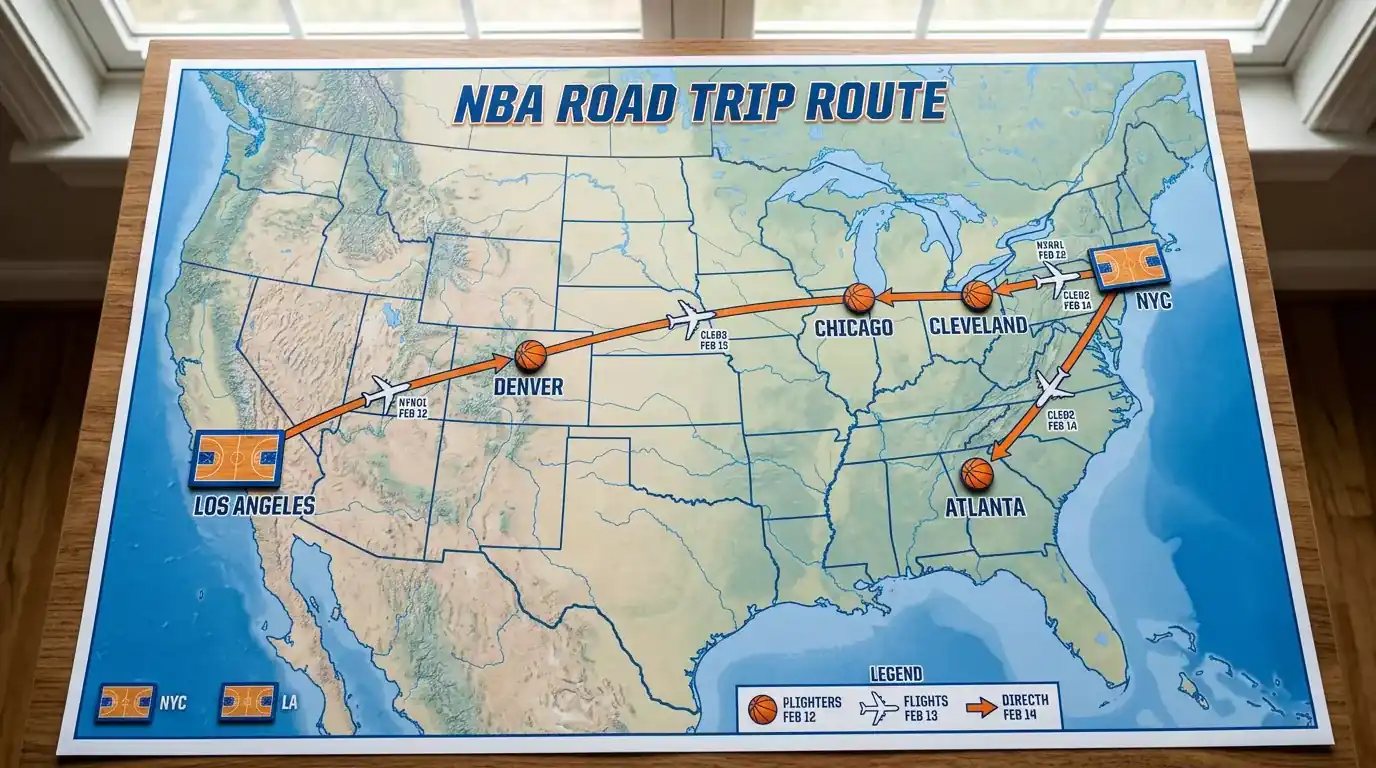
The NBA schedule creates clusters where road teams cross multiple time zones in a short period — typically five to seven-game road trips by West Coast teams playing Eastern Conference opponents, or East Coast teams heading through the Mountain Time Zone into the Pacific. The time zone component of these road trips creates a genuine physiological challenge: circadian rhythm disruption reduces reaction time, cognitive performance, and physical recovery.
Home teams win around 58-60% of regular season games, and a portion of that advantage is attributable to visiting teams having absorbed travel. When the visiting team has specifically crossed two or more time zones in the 48 hours before the game, research on NBA performance data suggests a modest but real performance decrement — typically reflected in slightly worse defensive efficiency and slightly higher turnover rates. The offensive numbers are less affected, possibly because offensive skills are more automatic and less dependent on peak reaction time.
The betting application requires nuance. A team on a road trip that has already played three away games successfully is in a different physiological state from one arriving for their first road game after a long flight. Accumulated road fatigue is more impactful than a single journey. Teams late in long road trips, particularly when playing time zones removed from their home city, are where travel fatigue most reliably creates exploitable spread discrepancies.
Altitude: Evidence-Based Assessment of the Margin Impact
Denver is the NBA venue most frequently cited for altitude effects. The city sits at around 5,280 feet above sea level — approximately 1.6 kilometres — which measurably reduces available oxygen for visiting athletes who are not acclimatised. The effect is genuine: visiting teams in Denver do show slightly reduced performance relative to their season averages, particularly in the first half before cardiovascular adaptation begins within the game itself.
The magnitude, however, is smaller than broadcast commentary implies. Across multiple seasons of Denver home game data, the altitude effect adds approximately one to two points to the home team’s effective spread advantage beyond what the standard home court adjustment would predict. That is real, but it is not a five-or-six-point swing. The Denver spread already incorporates a standard home court adjustment of 3-5 points; the altitude premium on top of that is roughly one to two additional points.
Other high-altitude venues in North American sports do not apply to the NBA directly, but the principle holds: altitude effects are genuine, modest in magnitude, and already partially priced into most bookmaker lines. The residual edge, if any, comes from identifying specific games where the visiting team’s altitude inexperience (perhaps their first Denver road trip of the season) or the altitude interaction with back-to-back fatigue creates a compounded disadvantage that the standard line does not fully capture.
Building a Travel Fatigue Filter: A Practical Checklist for Pre-Game Analysis
A practical travel fatigue filter for NBA betting analysis takes about three minutes to apply and produces a binary outcome: is travel a material factor in this game, and if so, in which direction does it point?
Start with the visiting team’s immediate schedule context. How many days ago was their last game? How far did they travel to reach this venue? How many time zones did they cross? Is this their first road game on a long trip or their fourth? Each of these inputs has a known direction — more fatigue factors point toward the home team being advantaged, less toward the matchup being travel-neutral.
Then assess whether the existing spread already reflects obvious travel factors. A team arriving for game four of a five-game road trip, having played the night before, in a high-profile game with significant public interest — that context is well-known and has likely been priced in aggressively. A team arriving for a moderately-fatigue situation in a lower-profile late-season game may carry residual pricing lag.
The final check is the home team’s own recent schedule. A home team that itself has been on a compressed schedule of three games in four nights, now finally getting a home game, may be more fatigued than their venue advantage suggests. Home court advantage does not erase travel fatigue — it compounds with it when both teams are in similar physical states, and the net effect is closer to neutral than a simple home/road framework implies. The interaction between travel fatigue and the back-to-back scheduling analysis is covered in the related guide on how NBA scheduling creates betting edges.
Does playing in Denver (high altitude) measurably affect visiting team performance?
Yes, with caveats. Visiting teams in Denver do show slightly reduced performance metrics relative to their season averages, particularly in the first half before within-game cardiovascular adaptation occurs. The effect adds approximately one to two points to Denver’s effective home advantage beyond the standard 3-5 point home court adjustment. This effect is genuine but modest, and Denver’s spread typically incorporates it. Residual edge exists in specific situations — visiting teams on their first Denver road trip, or arriving on no rest — where the altitude effect compounds other fatigue factors.
How many time zones do the most-travelled NBA teams cross in a single road trip?
West Coast teams (California franchises, Portland, Phoenix) regularly cross three time zones on full Eastern Conference road trips, covering Pacific to Eastern time. The longest individual road trips — particularly when combined with Mountain Time Zone stops — can involve crossing three time zones within a five-day window. East Coast teams heading west face the same three-zone differential in the opposite direction. The three-zone crossing is the most impactful single travel transition in terms of measured performance effects.
Published by the nba Bets of the day team.