Evaluating Free NBA Tips UK
 Available in US
Analyzing Free NBA Tips and Tipster Authenticity
The word “free” in NBA betting tips is one of the most misleading labels in the industry. Not because the tips cost money — they often genuinely do not — but because “free” implies the service is operating in your interest, which is rarely the whole story. Every free NBA tips service has a revenue model, and understanding that model tells you a great deal about how much weight to place on the picks themselves.
Affiliate-funded tipster sites earn commission when you register with a bookmaker through their links. Their financial incentive is to generate registrations, not necessarily to produce profitable tips. Community platforms like OLBG operate on engagement — the more picks posted, the more traffic, regardless of whether those picks perform. A handful of sites publish tips as content marketing for a subscription analytics service or a paid membership tier. In each case, the free tips serve a commercial purpose, and that purpose shapes what gets published and how performance records are maintained.
None of this means free NBA tips are worthless. Some are genuinely useful, particularly from tipsters on community platforms who have built verified long-run track records. The skill is knowing how to distinguish the valuable from the noise, and that requires understanding exactly three metrics.
Strike Rate, ROI, and Sample Size: The Only Three Numbers That Matter
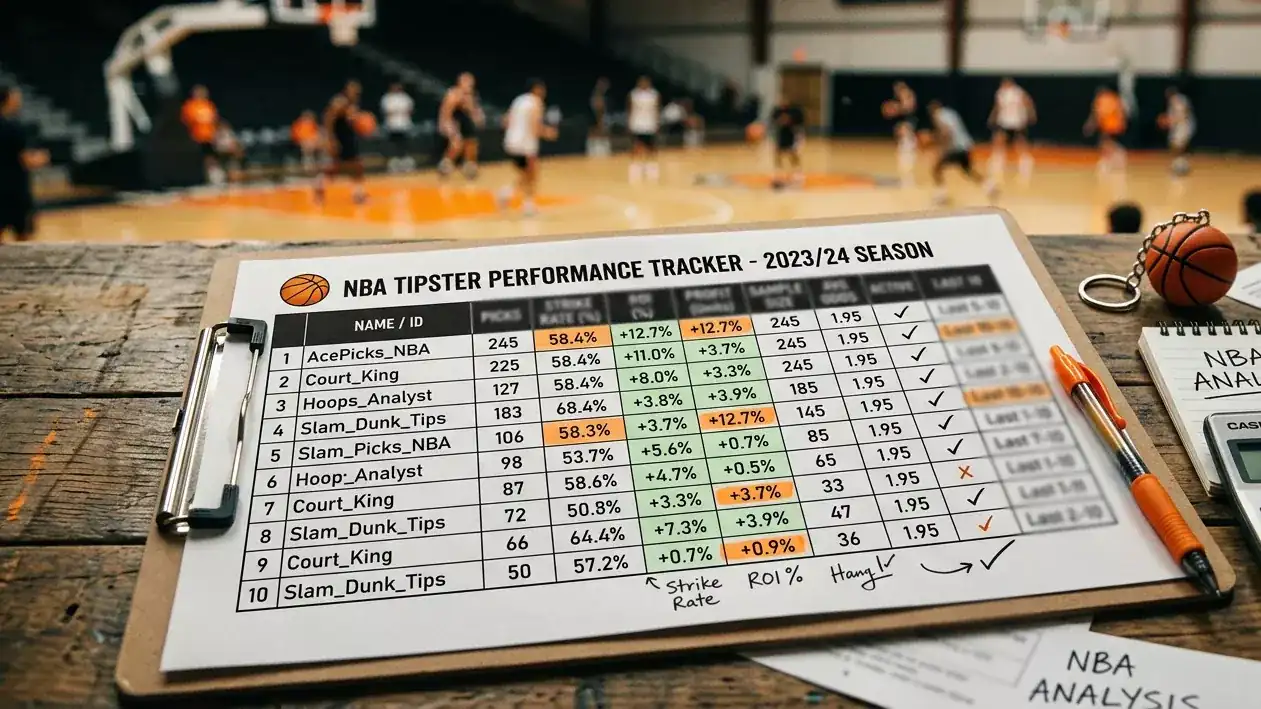
Strip away all the narrative around a tipster’s picks and you are left with three numbers that determine whether a service is worth following: strike rate, return on investment, and sample size. Everything else — the confidence ratings, the analytical write-ups, the claimed inside sources — is context at best and distraction at worst.
Strike rate is the percentage of tips that win. An NBA tipster with a 55% strike rate on spread picks is performing meaningfully above the breakeven threshold, which sits around 52.4% at standard -110 odds. A 45% strike rate is losing money regardless of how impressive the analysis sounds. The problem is that strike rate alone, without knowing the average odds, tells you nothing about profitability.
Return on investment (ROI) combines strike rate and odds into a single profitability figure. A tipster posting 10% ROI over a meaningful sample is generating genuine profit — betting £100 per tip produces £110 back over time. Academic work on NBA prediction models finds that AI-driven tools achieving 73-74% accuracy on five-star picks, as reported by platforms like OddsTrader, are genuinely uncommon. Most free tipsters operate at lower accuracy on less selective samples. An ROI of 5-10% sustained over 200-plus tips is excellent; anything above 15% over a small sample should be treated with scepticism until the sample grows.
Sample size is where most free tip evaluation goes wrong. A tipster with 20 picks and a 65% strike rate might be very good, or might be in a variance run. Statistically, you need around 100-150 picks at the same stake level to begin distinguishing genuine skill from luck. For NBA betting specifically, where a season runs roughly October to June, that means evaluating a tipster across at least one full season before drawing conclusions, and ideally two or more. The research framework for understanding prediction accuracy is grounded in the same principles covered in our guide on finding expected value in NBA betting.
How Community Tipster Platforms Track NBA Picks in the UK
UK-based community platforms that rank tipsters — and there are several active ones — typically track picks with timestamps to prevent backdating, display profit and loss in units rather than cash, and show the bookmaker the tip was placed at. This last point matters: a tip placed at 3/1 that you actually manage to get at 5/2 is a different proposition to one published at 3/1 that was already down to 11/4 when you saw it.
The best community platforms show historical odds at the time of posting alongside current settled odds, which lets you calculate how much the price has moved since publication. They also distinguish between different bet types — spread picks, player props, totals — which matters because a tipster with a strong record on totals but a poor record on player props is only worth following for the market where the demonstrated edge lies.
What these platforms cannot protect against is selective memory: a tipster who posts tips freely when they feel confident and goes quiet during cold runs is showing you a filtered record, not a true one. Look for tipsters with consistent posting frequency across both good and bad runs. A tipster who posts 5-8 tips per week regardless of recent form is demonstrating process discipline. One who posts 15 tips during a hot streak and three during a cold one is curating their apparent record.
Five Red Flags That Signal an NBA Tipster’s Record Isn’t Worth Your Stakes
After nine years of watching tipster services come and go, the warning signs are consistent. A published record with no losing months anywhere in its history is the most obvious — variance in sports betting is inescapable, and anyone claiming a clean long-run record has either been selective with what they publish or has a very short track record.
The second red flag is unusually high odds as a consistent average. A tipster whose average winning odds are 5/1 and above is betting on long-shot outcomes, which naturally produces exciting wins but brutal losing streaks. The ROI on high-odds strategies is difficult to sustain over large samples because the variance is extreme. Be sceptical of any service where the “legendary winners” are highlighted without equal prominence given to the losing run that will inevitably accompany them.
The third is the absence of losing bets in the published record. Every active tipster has losing bets. A feed where only winners appear is not a record — it is marketing content. Real tipster records show the full picture including losing bets, losing weeks, and occasional losing months.
The fourth red flag is a record that only began tracking from a conveniently recent date. “Started tracking picks in January 2026” from a service that has been publishing tips since 2022 should prompt questions about what happened to the earlier record.
The fifth is guaranteed profit claims. No legitimate NBA tipster service guarantees profit. Sports betting involves variance, and any service promising assured returns is either misrepresenting their product or running something that resembles a scam more than a tipster service. Credible services talk about expected value, long-run ROI, and maintaining discipline through losing runs — not guarantees.
What strike rate should a good NBA tipster maintain over a season?
On standard -110 spread odds, the breakeven strike rate is around 52.4%. A tipster consistently posting 55-58% over 150-plus picks is performing genuinely well. Anything above 60% across a large sample is exceptional and should prompt scrutiny of the sample before accepting it at face value. For player prop or totals picks where odds vary more, ROI is a more useful benchmark than strike rate alone.
Is it possible to profit long-term from free NBA tip services?
Yes, but selectively. Community platform tipsters with verified multi-season records and positive ROI represent genuine value. The key is identifying those few among many. Most free tip services, particularly those funded by affiliate revenue, optimise for engagement rather than performance. A rigorous evaluation process — looking at sample size, ROI across different bet types, and consistency of posting — separates the useful services from the noise.
Prepared by the nba Bets of the day editorial staff.