NBA Over Under Picks UK 2026
 Available in US
NBA Totals Betting: Analyzing Over/Under Lines
Most punters look at a totals line and think it represents the bookmaker’s best estimate of the final combined score. That is partially true, but it misses the more important half of the picture. The line is primarily set to attract equal money on both sides of the bet — the number that maximises bookmaker margin, not necessarily the one with the highest predictive accuracy.
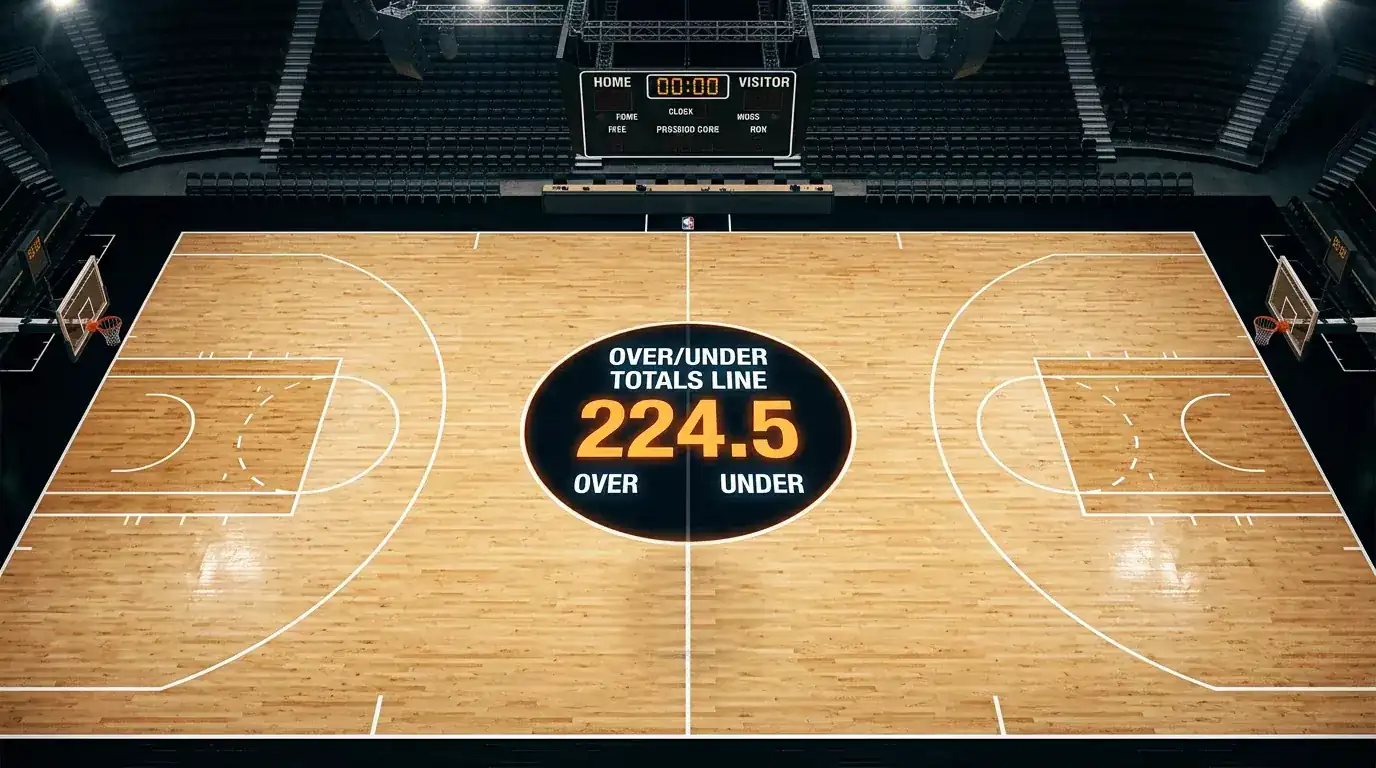
The over/under, or totals market, is a bet on whether the combined points scored by both teams will be higher or lower than a set figure. A line of 224.5 means you are betting on whether both sides together will score 225 or more (over) or 224 or fewer (under). The .5 eliminates the possibility of an exact tie result — what US bettors call a “push” — which matters for settlement purposes on UK platforms. Most UK bookmakers also display this as “total points” in the NBA section, so if you cannot find “over/under” by label, look for that alternative.
Understanding that the line is a market-clearing price rather than a pure forecast is what separates informed totals betting from guesswork. The edge comes from identifying where the bookmaker’s incentive to balance the book has created a number that diverges from the statistically likely scoring total. That divergence is most consistently found by analysing pace and offensive efficiency before the game.
Pace and Offensive Rating: The Two Stats Behind Every Totals Line
I built my first NBA totals model purely around pace of play and offensive rating, and it outperformed everything else I tried in that early period. That is not a coincidence — these two metrics are the fundamental inputs into any serious totals projection, and the research backs it up.
Pace is measured as the estimated number of possessions per 48 minutes. A high-pace team generates more possessions, which means more scoring opportunities for both sides. Two high-pace teams meeting each other creates a structural bias toward the over, all else being equal. Two low-pace, defensive outfits push the scoring expectation down. Pace is publicly available from multiple basketball statistics databases and updates continuously through the season.
Offensive rating — points scored per 100 possessions — captures how efficiently a team converts those possessions into points. A high-pace, low-efficiency team might generate fewer points than a moderate-pace, high-efficiency outfit. The interaction between pace and efficiency is what produces a mathematically grounded projected total. Multiply possessions by efficiency, account for both teams’ defensive ratings, and you have a number you can compare against the bookmaker’s line.
Systematic prediction models applied to NBA game data show accuracy in the 65-80% range is achievable using a range of statistical features, with pace and offensive/defensive rating consistently among the highest-ranked predictors across multiple academic studies. For a UK punter doing manual analysis, focusing on these core metrics delivers the best return per hour of research time.
Situational Totals: When Rest, Travel, and Scheduling Shift the Number
Even a well-calibrated pace and efficiency model can miss on totals when situational factors override the baseline stats. I have been caught out enough times by ignoring the schedule to treat this section as optional reading — it is not.
Back-to-back games reduce scoring output, particularly in the fourth quarter. Fatigued teams slow their pace and become less precise offensively. The net effect is frequently an under-friendly environment even when the teams’ season averages point toward an over. The bookmaker sets the line based on season-average inputs; the actual game plays out with exhausted rosters. That gap is where the edge sits, and it is consistent enough to be a systematic filter rather than a game-by-game judgement call.
Travel clustering matters too. When a road team has crossed multiple time zones and played three games in four nights, their offensive output in the final game of that stretch typically drops below their season average. The effect is smaller than back-to-back fatigue but measurable across large samples. Combine travel with an opponent that plays deliberately slow, and an under that looked borderline suddenly becomes compelling.
For a complete breakdown of how scheduling and fatigue interact with NBA markets, the guide on back-to-back scheduling as a betting edge covers this in full.
Getting the Best Price Before the Totals Market Closes: When to Bet Over/Under Early
Totals markets open, typically several hours before tip-off, at a number reflecting the bookmaker’s initial projection. They then shift as money flows in from sharp bettors and the broader public. The closing line is almost always a more accurate reflection of true probability than the opening line — sharp bettors move it toward fair value over the course of the day.
The practical implication: if your analysis points toward an over and you have identified a genuine edge, placing early — before sharp money pushes the line up — captures a better price. If the line then moves in your predicted direction after you bet, that is evidence your analysis was correct. This is what practitioners call closing line value, and it is the most reliable long-run indicator that your totals model has real merit rather than short-run variance.
The reverse applies for unders. Public money typically flows toward overs in high-profile games — casual bettors want to see scoring and act accordingly. This bias tends to inflate the opening over/under line slightly, creating systematic under value in games that sharp money has identified as lower-scoring than the public expects. Understanding when to place matters as much as what to place in the totals market.
One practical note for UK punters: the timing of NBA games means most tip-offs fall between 1:00 and 4:00 in the morning GMT. Totals lines will have absorbed a full day’s worth of movement before you are likely placing your bet unless you set alerts or check before going to sleep. Getting into the habit of reviewing lines in the early evening — when US sharp action is beginning but UK public money is not yet heavily flowing — often yields better prices than betting at the last moment before tip-off.
How is the NBA totals line calculated by UK bookmakers?
UK bookmakers use a combination of team offensive and defensive ratings, pace of play, and situational factors like home/away splits and rest days to set an initial line. The line then adjusts based on incoming bets to balance exposure. The result is a market price rather than a pure forecast, which means it can diverge from the statistically likely scoring total when public betting preferences create imbalance on one side.
Does pace of play change significantly across the NBA season?
Yes, meaningfully so. Early-season pace tends to be slightly elevated as teams are in rhythm-finding mode and defensive schemes are not yet fully embedded. Mid-season pace settles closer to each team’s true level. Late-season pace can slow in games where playoff seeding is secured and coaches manage minutes conservatively. For totals betting, rolling 15-20 game pace averages are more useful than full-season figures, particularly from February onwards.
Prepared by the nba Bets of the day editorial staff.