NBA Player Props Today: UK Betting Markets
 Available in US

- NBA Player Props: Value in UK Specials Markets
- Points, Rebounds, Assists, and Beyond: The Full Prop Menu
- Which UK Bookmakers Offer the Deepest NBA Prop Markets
- Usage Rates and Minutes: The Stat Behind Every Prop
- How Matchup Data Changes a Player’s Projected Line
- Reading the NBA Injury Report Before Placing a Prop Bet
- What Predictive Models Say About Player Prop Accuracy
- Combining Props in a Bet Builder: Correlation Risks UK Bettors Ignore
- NBA Player Prop Betting: Questions From UK Punters
NBA Player Props: Value in UK Specials Markets
Basketball engagement in the UK has grown faster than almost anyone in the betting industry predicted. According to EY-Parthenon’s Sports Engagement Index, basketball rose seven positions in 2025 to become the sixth most popular sport among UK adults aged 18 to 24 — ahead of rugby union, golf, and cricket in that demographic. That audience did not arrive looking to bet match winners. They arrived knowing individual players, following social media accounts, and thinking about performances. Player props are the natural betting expression of that fandom.
On UK platforms, you will find player performance markets labelled as “specials” or “player specials” rather than “props”, the American terminology that dominates NBA betting discourse. Same markets, different name. These bets ask whether a specific player will score more or fewer points than a given line, grab more or fewer rebounds, dish out more or fewer assists, or achieve various combinations of those categories. The line is set by the bookmaker based on the player’s projected output for that specific game against that specific opponent.
What makes props interesting from an analytical standpoint is that they are systematically harder for bookmakers to price than game-level markets. A team’s offensive rating is measured across hundreds of possessions; a player’s points line for one game is influenced by opponent defensive assignment, pace, foul trouble potential, and rotation decisions that are partially unpredictable. That complexity creates pricing inefficiencies, and those inefficiencies are the foundation of the edge I am going to walk you through in this guide.
Once you find strong individual player edges, you can combine them using our NBA parlay picks to maximize your potential returns.
Points, Rebounds, Assists, and Beyond: The Full Prop Menu
The points line is the most widely available and heavily traded prop market. It is also the most efficiently priced, partly because it attracts the most attention from sharp bettors and partly because scoring data is the most abundant and easily modelled statistical category. If you are starting out with player props, the points market teaches you the mechanics cleanly. Just do not expect it to be where the softest lines live.
Rebounds props are a different animal. Rebounding is inherently variable on a game-by-game basis because it depends heavily on how many missed shots there are in a game, where those misses land, and which players happen to be in position when they do. A centre whose rebounding average looks stable over a 20-game sample can swing by four or five boards from game to game based on game pace alone. That variance is both a challenge and an opportunity: books set lines based on rolling averages that sometimes fail to account for specific matchup contexts that push the number meaningfully higher or lower.
Assists props are increasingly popular and arguably among the softer markets on offer. Assist rates are tied tightly to pace of play and to the specific offensive configuration a player operates within. A primary ball-handler whose team plays at the top of the league in pace will accumulate assist opportunities at a systematically higher rate than the same player on a slower team. Mid-season trades or lineup changes can create a lag in how quickly those assist lines recalibrate.
Beyond the three core categories, many UK platforms now offer combined markets: points plus rebounds, points plus assists, points plus rebounds plus assists (PRA), steals and blocks combined, and double-double or triple-double propositions. These combined bets carry higher margins because correlation between statistical categories is difficult to price accurately, but they also offer interesting angles when one component is clearly mispriced and positively correlated with the others. I approach combined markets with caution and use them selectively. The correlation risk cuts both ways.
Across all these market types, the volume of active online accounts betting on real sports events in the UK has grown substantially. The Gambling Commission’s most recent data puts monthly active accounts at around 13.5 million for Q4 2024/25. A meaningful portion of that activity flows through player markets, which means the pricing quality on popular players has improved. The edge is real but narrower than it was five years ago, which makes matchup-level analysis more important, not less.
One category that deserves specific mention for UK bettors is the “first scorer” and “anytime scorer” market, widely available on UK platforms and technically a prop, though one with a different analytical framework from over/under performance lines. These markets ask whether a player will score a basket at any point in the game, which is essentially a starting lineup and minutes confirmation bet. They are popular but structurally difficult to exploit because the margin is high and the outcome binary in a way that amplifies variance. I include them here for completeness rather than as a primary analytical target.
Which UK Bookmakers Offer the Deepest NBA Prop Markets
Player props are not uniformly available across all UK platforms, and the depth of coverage varies significantly depending on the game and the time of season. For a regular-season mid-week game between two non-marquee teams, you might find only a handful of player markets on smaller platforms, while larger operators offer 30 or more individual player lines per game.
Betfair’s exchange format creates an interesting niche for props: because other bettors are setting the prices rather than the platform, lines on popular players occasionally reflect genuine consensus rather than bookmaker margin. The limitation is liquidity, finding enough on the other side of a prop position on Betfair can be difficult for games with modest UK interest. For regular-season games between western conference teams that tip off at 3am UK time, exchange liquidity on props is thin.
The practical approach I use is to check the depth of the prop market on two or three platforms before committing to a specific player analysis. If a player I am interested in only has a points market available (no rebounds or assists), that limits the analytical angles I can take. If the same player has five or six individual lines plus combined markets, the research investment goes further.
Usage Rates and Minutes: The Stat Behind Every Prop
Before I look at any player’s points line, I look at two numbers: their usage rate and their projected minutes. Everything else (shooting percentage, opponent defensive rating, pace) is noise without those anchors.
Usage rate measures what percentage of a team’s possessions a player uses when they are on the floor: through field goal attempts, free throw trips, or turnovers. A player with a 30% usage rate is involved in nearly one in three possessions on the court; a player at 18% plays a supporting role. The points line should reflect that usage rate, but it often reflects recent results instead. A player coming off a cold shooting game will see their line drop even if their usage rate remains the same.
The minutes projection matters because it interacts with usage in obvious ways: a player who typically plays 32 minutes and logs 25 usage generates a certain volume of attempts and scoring opportunity. If they are on a minutes restriction due to a minor injury, or if their team is playing a back-to-back and managing their load, the same per-minute production produces a lower total. The NBA’s official injury report, released roughly six hours before tip-off, is the primary source for minutes management flags. As researchers at Bryant University have noted in their predictive modelling work, the NBA.com statistical database makes the underlying data freely accessible in a way that few professional leagues match.
In practice: if a player’s usage rate over the last ten games is materially higher than what their current points line implies, and there is no minutes restriction or notable defensive assignment change, that divergence is worth investigating as a potential over. If their usage has dropped because a teammate has returned from injury and reclaimed their offensive role, a prop line that has not fully adjusted yet is a potential under candidate.
This sounds simple because it is. The complexity comes from tracking it across a 15-game slate in real time, which is why building a basic pre-game data pull becomes important for anyone betting props seriously.
How Matchup Data Changes a Player’s Projected Line
Two players with identical statistical profiles going into a game will have materially different expected outputs if one is facing a team ranked second in the league at defending their position and the other is facing a team ranked 28th. Yet bookmakers often lag in fully adjusting prop lines for defensive matchup quality, partly because modelling individual defensive assignments is genuinely difficult, and partly because most recreational bettors do not check this information.
The relevant metric for assessing defensive matchup quality varies by statistical category. For points, you want to know how many points guards (forwards or centres, depending on the player’s position) that team has allowed per game, and how that compares to league average. A team allowing 8% more points to opposing guards than the league average is a meaningful positive context for a guard’s points prop. A team allowing 12% fewer is a meaningful negative.
Stacked ensemble machine learning models applied to NBA outcomes data — the kind used in academic work examining the 2021 to 2024 seasons — rely heavily on SHAP analysis to identify which variables carry the most predictive weight. Opponent defensive efficiency repeatedly surfaces as a top predictor for individual scoring outcomes. This is not a profound insight. It is confirmation that what good prop bettors have been doing manually for years is statistically validated.
For rebounds, the relevant matchup variable is the opponent’s offensive rebounding rate. Teams that miss more field goals and attack the glass aggressively create more rebounding opportunities for the defending centre. A centre whose rebounding line looks modest might be set to surpass it against a team that attacks the offensive glass heavily and generates a high volume of misses. More missed shots create more opportunities to rebound.
The matchup analysis for assists requires understanding the opponent’s defence-to-assist ratio: how effectively they contain ball movement and force isolation rather than ball-sharing offense. Some defensive schemes generate lots of turnovers that kill assist opportunities; others allow free ball movement that pads assist numbers for primary distributors. Checking the opposing team’s defensive tendencies around ball movement is the relevant lens here.
Reading the NBA Injury Report Before Placing a Prop Bet
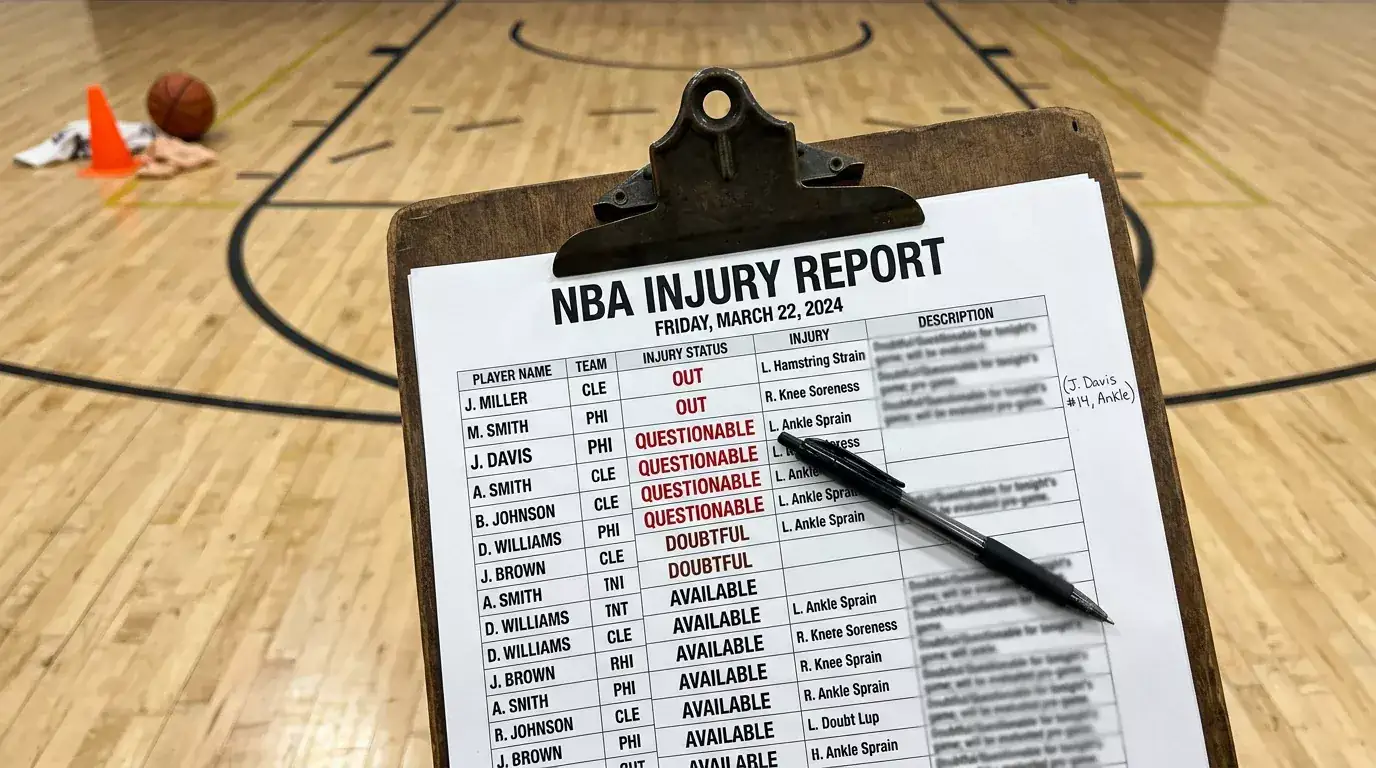
The NBA injury report is the single most important document in pre-game prop analysis, and it is publicly available, but its impact on UK bettors is complicated by timing. Reports are released roughly six hours before tip-off, which means a 1am UK tip-off generates its report at around 7pm local time in the US Eastern zone. For UK bettors, that is around midnight. If you are betting a midnight tip-off after doing your analysis at 9pm, you have a three-hour window where new information could invalidate your work.
The injury designations matter in specific ways for props. A player listed as “questionable” may play restricted minutes even if they take the floor. Their points line does not automatically adjust down for a potential 24-minute night instead of their usual 34. A teammate listed as “out” immediately changes the usage context for everyone else in the rotation: if the team’s third-highest usage player is confirmed out, the player you are betting on will absorb some of those possessions.
My standard process is to lock in no prop bets until the final injury report has dropped and lines have had 20 to 30 minutes to react. Line movement after the injury report is public information. It tells you what the market thinks about the impact. A player whose points line moves from 22.5 to 25 after a teammate is ruled out has just had their usage context upgraded by the market. Whether that upgrade is sufficient or excessive is where your analytical judgment comes in.
What Predictive Models Say About Player Prop Accuracy
The research on machine learning accuracy in NBA outcome prediction has grown substantially since 2020. A systematic review of 34 studies covering the 2019 to 2024 period, published in PLoS ONE, found that predictive models using between 20 and 60 input features achieve accuracy rates in the 65% to 80% range for game-level outcomes. Player-level prop prediction is a harder problem, but the same modelling principles apply: more relevant features improve accuracy; irrelevant features add noise.
For practical prop betting purposes, the key implication is that model-based lines, the kind generated by AI-powered odds engines, are incorporating far more information than the average bettor checks manually. The 5-star picks on AI-assisted platforms show average accuracy around 73%, according to published performance data from those services. That is a real edge over random selection, but it is not 80% accuracy, and it is not consistent across all bet types or all market conditions.
Where models underperform most reliably is in situations with novel inputs: a player returning from injury for the first time in several weeks, a new trade deadline acquisition playing in their first game with a new team, a rookie experiencing the “wall” effect in February and March. These scenarios involve regime changes that historical training data does not represent well. This is where manual analysis, including reading beat reporter context and understanding the coach’s language around player roles, adds value that automated models cannot easily replicate.
I do not use prop betting models as black-box answers. I use them as a starting point for identifying lines that deserve closer manual inspection. When a model disagrees significantly with the posted line and I can identify a structural reason for that disagreement, a matchup advantage, a usage shift, an opponent defensive weakness, that convergence between model signal and manual rationale is where I feel best about committing a stake.
Combining Props in a Bet Builder: Correlation Risks UK Bettors Ignore
Same-game parlays — called “bet builders” on most UK platforms — are the fastest-growing format in sports betting. The ability to combine a player’s points over with their team’s spread cover in a single bet creates the potential for amplified returns from one game. The problem is that correlation, which is the whole point of a same-game parlay, is also the thing that inflates the book’s margin most aggressively.
When two outcomes are positively correlated — a team winning big while their star player scores a lot — that combination should theoretically pay less than an independent parlay of those two events. Bookmakers build that correlation premium into their bet builder pricing. The question for bettors is whether the posted parlay price is fair relative to the true correlated probability, or whether it is excessively penalised.
The clearest example of dangerous negative correlation in a bet builder: backing a player to score over their points line while also backing the game to go under the total. If the game goes under, it means less scoring overall, which works against your player’s over. Those two legs are working against each other. The combined bet pays less than an independent parlay, and the outcomes are fundamentally in tension. Yet this combination is placed regularly by bettors who do not think through the relationship.
For UK bettors building props into same-game parlays, I recommend thinking in terms of game script. If you believe Team A will win decisively, what does that mean for their star player’s individual lines? A blowout win typically reduces fourth-quarter minutes for stars, which hurts late-game stats. A close game produces more minutes and more usage. Before combining any prop with a spread or total, explicitly ask: do these outcomes help or hurt each other? For more detail on the specific mechanics of bet builder construction, the same-game parlay guide covers correlation risks and optimal leg selection in depth.
Discover the most accurate daily projections directly on the nba Bets of the day homepage.
NBA Player Prop Betting: Questions From UK Punters
Are player prop bets the same as ‘specials’ on UK bookmakers?
Yes — ‘specials’ and ‘player props’ refer to the same market type. UK platforms adopted ‘specials’ as a generic label for individual player performance bets, covering points, rebounds, assists, and combinations. The underlying mechanics are identical: the bookmaker sets a line for a player’s projected statistical output, and you bet whether they go over or under that number.
How do I find a player’s usage rate before betting on their points line?
Usage rate data is available free on NBA.com, Basketball-Reference, and various stats aggregator sites. Look for the ‘advanced stats’ or ‘on/off’ section for the player you are researching. Usage rate is expressed as a percentage of team possessions used. Cross-reference their recent 10-game usage trend against their posted points line — a consistent 28% usage player with a points line of 18.5 is likely underpriced relative to their actual possession volume.
Can I combine NBA player props in a same-game parlay on UK platforms?
Yes, most major UK platforms offer a bet builder feature that lets you combine player props with spread and total markets in a single game. The key consideration is correlation: combining legs that are positively correlated — a player scoring a lot in a game their team wins big — is acceptable if the price reflects that relationship. Combining negatively correlated legs — a player over on points with the game going under the total — produces a structurally flawed bet regardless of price.
How does injury news affect player prop lines?
Injury news is the most powerful single force on player prop lines. A star player listed as out creates immediate usage redistribution for their teammates — their points, rebounds, and assists lines will shift upward as the market reprices their roles. The timing matters: lines adjust within minutes of official confirmation, so checking the injury report as soon as it drops (roughly six hours before tip-off in US Eastern time, which is late evening in the UK) gives you the best chance of acting on repricing lags.
Written by the editors at nba Bets of the day.