NBA Spread Betting Tips UK 2026
 Available in US

- NBA Spread Betting Mechanics and UK Handicap Markets
- How the Point Spread Is Set and What Moves It
- Handicap vs Spread: Navigating UK Bookmaker Terminology
- ATS Records and Why They Matter More Than Win-Loss
- Home Court and Spread: Quantifying the Scheduling Edge
- Line Shopping Across UK Bookmakers: Where Half-Points Matter
- Five Spread Betting Mistakes UK NBA Punters Make Repeatedly
- A Full Walk-Through: Picking an NBA Spread Bet Step by Step
- Your NBA Spread Betting Questions Answered
NBA Spread Betting Mechanics and UK Handicap Markets
The first time I placed an NBA bet on a UK platform, I spent ten minutes searching for the “spread” market before realising it was sitting right in front of me, labelled “handicap.” That small confusion cost me nothing in money, but it illustrated something important: the NBA betting vocabulary you pick up from American podcasts and Reddit threads does not always translate cleanly to what you see on bet365 or Sky Bet.
Spread betting in basketball is the most fundamental market in the sport. Rather than simply backing one team to win the game, you are betting on the margin of victory. The bookmaker assigns a numerical handicap to the favoured team: say, -7.5, which means that team must win by eight points or more for your bet to land. Back the underdog at +7.5 and they only need to lose by fewer than eight, or win outright, for you to collect.
The reason UK platforms use “handicap” instead of “spread” is largely cultural. The term spread betting already carries a specific and legally distinct meaning in the UK — it refers to financial spread betting products regulated differently from fixed-odds wagering. To avoid confusion with those regulated financial instruments, sportsbooks settled on “handicap” for the basketball point spread market. Same bet, different label. Once you understand that equivalence, the entire spread section of the NBA markets opens up immediately.
If you are confused by European and Asian formats, our detailed guide on NBA handicap betting in the UK breaks down the math perfectly.
How the Point Spread Is Set and What Moves It
Most bettors assume the spread reflects what the bookmaker thinks the final score will be. That is only half right. The opening line is an opinion about expected margin — but from the moment it hits the board, it becomes a balancing mechanism. The bookmaker’s goal is to attract roughly equal action on both sides, not to predict the final score with perfect accuracy.
The opening spread is set by a team of oddsmakers using a combination of power ratings, injury information, rest data, and historical matchup patterns. Those power ratings are built on metrics like offensive and defensive efficiency per 100 possessions, pace-adjusted net rating, and recent form weighted against schedule strength. The work that goes into the initial number is genuinely sophisticated. Platforms like Oddschecker process around 100 million projections per week and track roughly 125 million odds changes daily across their EV-scanning tools. That scale tells you the opening number is not guesswork.
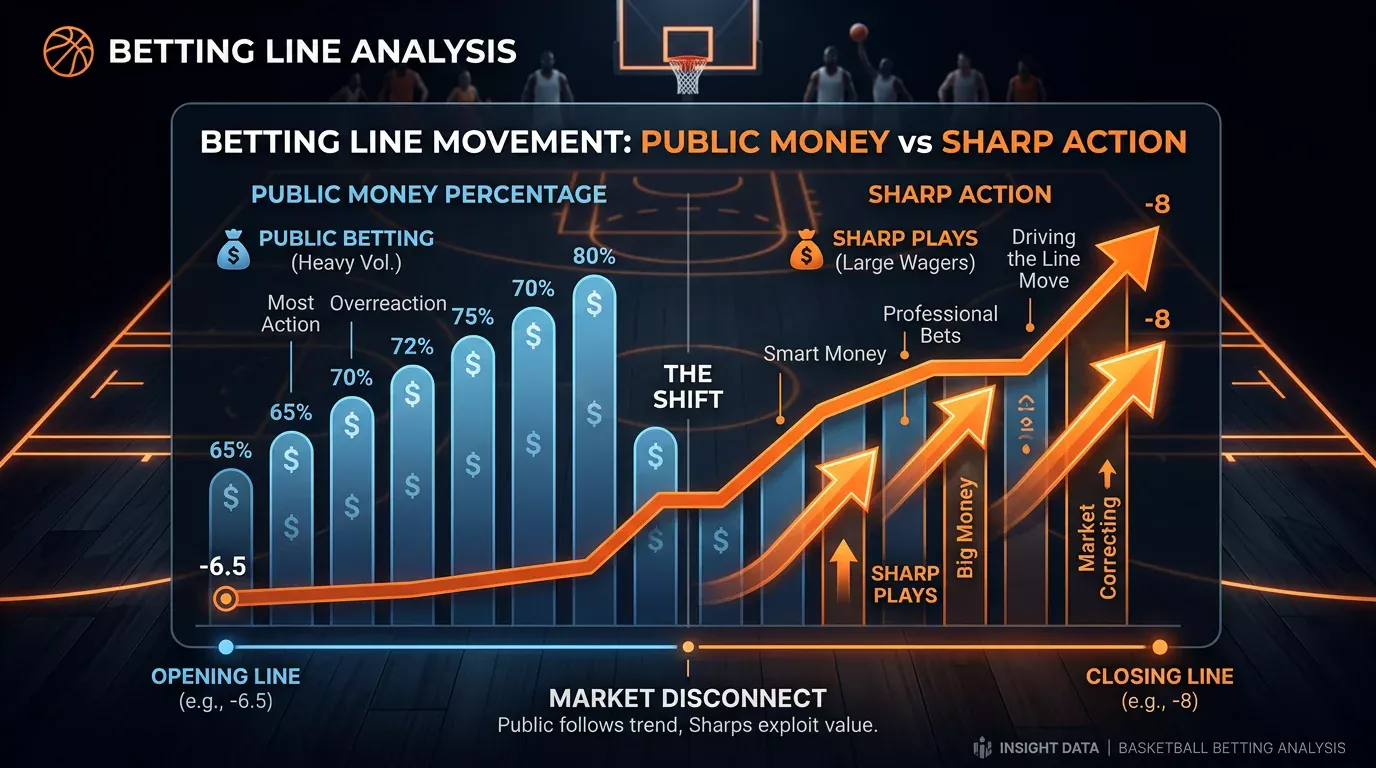
What moves the line after opening is a combination of three forces. The first is sharp money: bets placed by professional or semi-professional bettors whose historical accuracy forces the bookmaker to adjust. A sharp bet of meaningful size on one team signals that the original number may be off, so the book moves to reduce its exposure. The second force is public money: high-volume recreational betting on a popular team that shifts the line to rebalance the book’s liability. The third and most immediate force is news: a single injury tweet from a credible beat reporter can move an NBA spread by a full point or more within minutes of posting.
Understanding which force is driving movement matters. A line moving against the majority of ticket volume — reverse line movement — signals sharp action and deserves attention. A line moving with heavy public betting volume on a prominent team is usually just the book managing a liability imbalance. Treating those two scenarios as equivalent is one of the most common mistakes I see from recreational spread bettors.
Handicap vs Spread: Navigating UK Bookmaker Terminology
On most UK platforms you will encounter two flavours of handicap betting on NBA: the standard European handicap and the Asian handicap. They solve the same underlying problem, giving the underdog a notional head start — but they handle edge cases differently, and that difference directly affects your returns.
The European handicap uses whole numbers. If the line is -7 and the favoured team wins by exactly seven, the result is a push, and your stake is returned. This sounds benign, but it introduces an outcome that essentially cancels your bet without giving you any information about your edge. The Asian handicap eliminates the push by using half-point lines: -7.5 means the favourite must win by eight or more, full stop. No refunds, no grey zone. Most serious spread bettors prefer Asian lines precisely because the half-point makes every outcome binary.
You will also notice that some platforms label their NBA spread markets as “points handicap” or simply “handicap” without specifying Asian or European. In practice, if the line ends in .5, it is Asian. If it is a round number, check the platform’s rules page — some default to push settlement, others offer a “void” version. Reading the rules once per platform saves significant confusion later.
One more quirk specific to UK platforms: some show the handicap from the perspective of the favourite, others from the underdog. A line showing the underdog at “+7.5 to cover” is identical to showing the favourite at “-7.5 to cover.” Always check which team the displayed handicap is applied to before placing — confusing the direction of a spread bet is embarrassingly common even among experienced punters.
ATS Records and Why They Matter More Than Win-Loss
ATS stands for “against the spread” — it is the single most important performance metric in spread betting, and it is completely invisible in a team’s win-loss record. A team that wins 60% of their games straight up but only covers 45% of spreads is actively losing money for anyone who bets them without checking this distinction.
Here is why ATS records diverge from win-loss: the spread already prices in the quality differential between teams. When the market lines up a 10-point favourite accurately, that team winning by 11 covers; winning by 9 does not. The result and the cover are two separate events. A dominant team that consistently wins by exactly the spread margin — the sort of outcome where the books got it right — will have a mediocre ATS record despite an excellent straight-up record.
Franchise-level ATS data can be striking. Over a 2.5-season stretch from 2022/23 through to 2024/25, the Oklahoma City Thunder covered the spread in approximately 64% of their games at home — the best home ATS rate in the league over that period, per VSiN data. That is not a coincidence; it reflects a young team whose trajectory was systematically underestimated by opening lines that took time to recalibrate to their rapid improvement. Markets are efficient but not instantly so.
When I am researching a spread bet, I look at ATS records split by home and road, by rest situation, and by opponent quality tier. A team with a 55% ATS record at home might only cover 38% on the road. Treating those as one number destroys the signal. The home/road split alone filters out a significant chunk of spread bets that look attractive on the surface but fall apart when the context changes.
One important caveat: ATS records are more meaningful over larger samples. A team’s ATS record through the first 15 games of a season carries real uncertainty. By game 50, patterns become more reliable, though never perfectly predictive. The spread market, especially at the closing line, is competitive. Edges exist, but they are narrow and context-dependent.
Home Court and Spread: Quantifying the Scheduling Edge
Home court advantage in the NBA is one of the most consistently documented effects in professional sport. Home teams win approximately 58% to 60% of regular-season games, and when you translate that win probability into spread terms, the venue factor is worth somewhere between three and five points. Every competent oddsmaker builds that into the line automatically.
The practical implication for spread betting is that home court is already priced in. You are not gaining an edge simply by backing home teams. What gives you an edge is identifying situations where the home advantage is mispriced: either overstated because the home team is playing poorly in front of their crowd, or understated because the visiting team performs unusually well on the road against rested opposition.
As one analysis of multi-sport home advantage data noted, the NBA’s venue effect is more durable than in some other professional leagues — crowd noise, familiarity with the playing surface, and elimination of travel fatigue compound in ways that are harder to arbitrage away. That durability means home court is never irrelevant; it just needs to be assessed in combination with scheduling context rather than in isolation.
The most actionable home court angle I have found is pairing venue advantage with rest differential. A home team with two or more days of rest against a road team playing the second night of a back-to-back, a situation the NBA schedule produces dozens of times per season — represents a compounded advantage that lines do not always fully absorb, particularly mid-week when betting volume is lower. For a more detailed look at how scheduling fatigue affects the spread market across all game types, the back-to-back betting guide breaks down the specific statistical adjustments worth making.
Line Shopping Across UK Bookmakers: Where Half-Points Matter
If you are only using one bookmaker for your NBA spread bets, you are leaving money on the table every single week. The spread market across UK platforms is not uniform. At any given time, you might find a team at -6.5 on one platform and -7 on another. That half-point difference sounds trivial, but over a season of betting it compounds into something significant, particularly on games that land on key numbers.
Key numbers in basketball refer to the most common margins of victory. Unlike American football, where 3 and 7 are dominant key numbers due to scoring structure, basketball has a more distributed set — common finishing margins cluster around 1, 2, 3, 4, 5, 6, 7, 8, and 10. Games finishing exactly on your spread number are not rare events; they are statistically predictable frequencies. Getting -6.5 instead of -7 on a game that ends up going 7 points is the difference between a winning and a losing bet, and it costs nothing to shop for it.
Practically speaking, having two or three funded accounts across different UK-licensed platforms is the minimum setup for serious spread betting. Before placing any NBA handicap bet, check the number across your accounts. The whole process takes 90 seconds. The asymmetry is obvious: a fraction of your betting time spent comparing lines can improve your return on investment more than any amount of extra analysis.
Beyond the spread number itself, check the odds attached to each side. UK handicap markets are typically priced at around 10/11 (1.91 in decimal) on each side, but small variations exist. Getting 19/20 (1.95) instead of 10/11 (1.909) on a spread bet you would place anyway increases your long-run return by roughly 2% — not transformational, but real and cumulative. Over 200 bets in a season, those fractional differences in attached odds build into a meaningful sum.
Five Spread Betting Mistakes UK NBA Punters Make Repeatedly
Nine years of watching people bet on basketball — including some of my own early errors — produces a reliable list of where recreational spread bettors lose money that has nothing to do with their basketball knowledge.
The first mistake is ignoring closing line value. Most UK punters place their bets at whatever price is available when they check, often in the evening before a midnight tip-off. The problem is that the spread at 10pm UK time is frequently not the sharpest version of the line. Opening earlier, ideally closer to when the previous day’s games end and new lines post — gives you access to prices before sharp money has had a chance to move them. If you consistently find that the line has moved against you between when you wanted to bet and when you actually bet, the market is pricing your preferred side correctly after sharper money came in. That is a signal to reassess your process.
The second mistake is chasing narrative over data. A team that won their last five games straight up generates enormous media coverage and bettor enthusiasm. The spread already prices that momentum in — and often overprices it. Stacked ML models applied to NBA outcomes show predictive accuracy in the 65-80% range when trained on 20 or more statistical features, according to a systematic review of 34 studies published in PLoS ONE. Pure recency bias (essentially using a five-game sample) sits well below that threshold as a predictive mechanism.
The third mistake is treating all spread markets as equally liquid. Early-week lines for three-day-out games have less sharp money behind them. Late Sunday night lines on Monday games have had significant action. The efficiency of the line varies, and less efficient early markets are the ones where you occasionally find genuine value — but they are also more volatile before injury news clarifies.
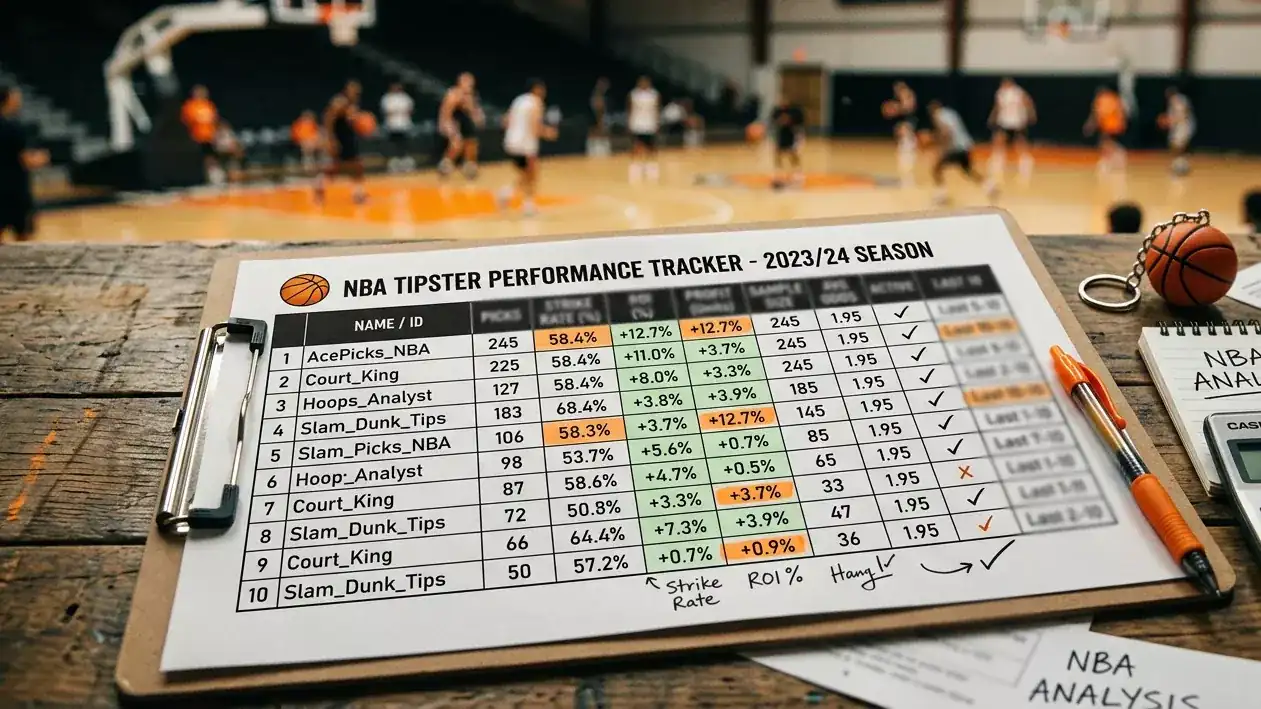
The fourth mistake is not tracking results by bet type. Lumping all spread bets into one P&L number hides whether your edge, if you have one, concentrated in a specific subset: home team favourites, road underdogs, totals-correlated plays. Without granular tracking you cannot identify what is actually working.
The fifth mistake is the most prosaic: not line shopping. I mentioned it above, but it bears repeating here because it is the single most correctable error in the list. Every half-point you fail to shop for is a small, avoidable loss. Fix it first; everything else is secondary.
A Full Walk-Through: Picking an NBA Spread Bet Step by Step
Let me walk through how I approach a spread bet in practice, using a hypothetical game to show the process without pinning it to a specific matchup that would be dated by the time you are reading this.
Step one is establishing the context. Say Team A is a -8.5 home favourite against Team B. My first question is: does this spread reflect the actual quality differential between these teams, adjusted for the current roster state? I pull both teams’ offensive and defensive ratings per 100 possessions over the last 20 games, weighted towards the more recent. I am not looking for the best team; I am looking for a mismatch between what the spread implies and what the underlying efficiency numbers suggest.
For daily updated odds and expert analysis, always check the best UK NBA betting site before placing your wagers.
Step two is the rest and scheduling check. Is either team on the second night of a back-to-back? Has Team A played three games in four nights recently? A rested home team against a fatigued road team at -8.5 is a different proposition from a rested road team against a back-to-back home side at the same number. Rest differentials affect both spread and totals outcomes, and they are public information available before the line opens.
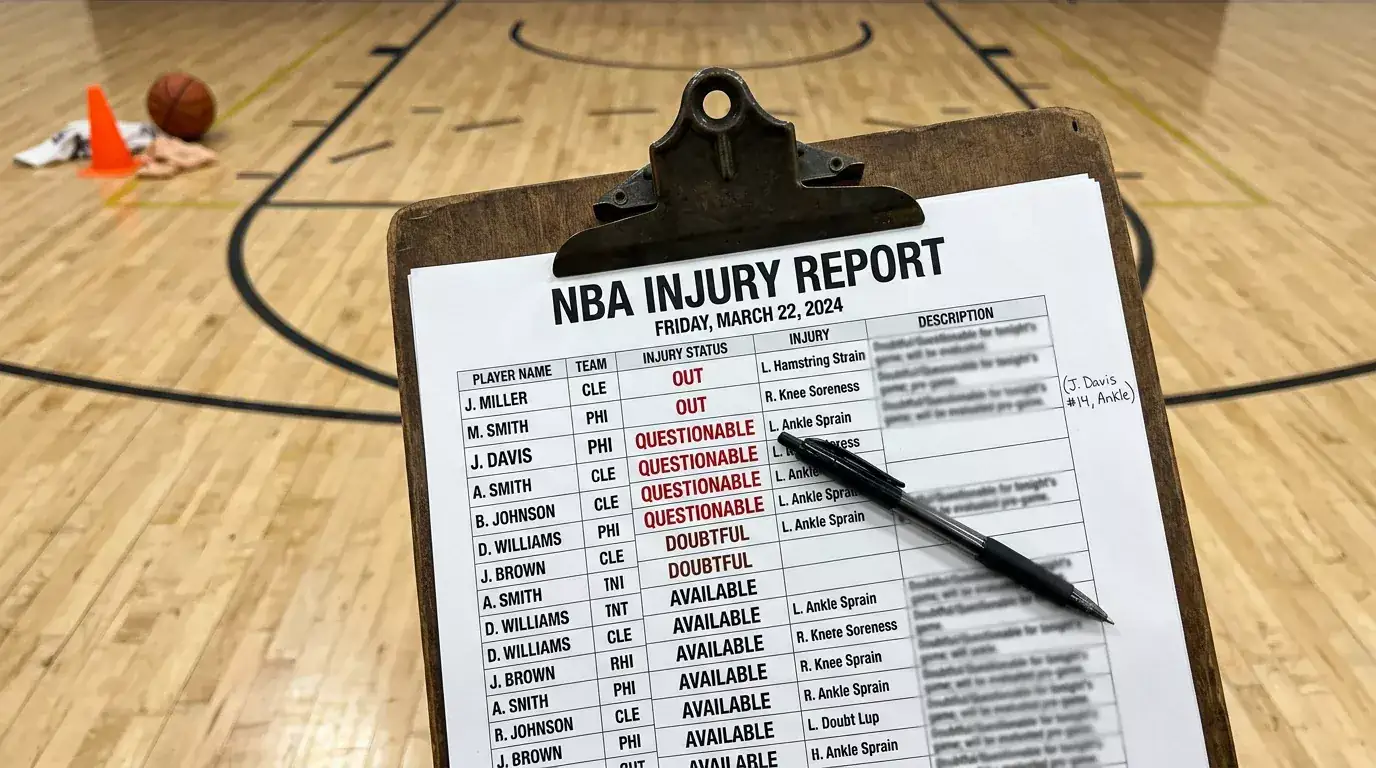
Step three is the injury report. This is non-negotiable. An NBA injury report for games day is typically released in the early afternoon US Eastern time — which is early evening to late evening in the UK. If a star player is listed as doubtful or out after you have already found value in the spread, you need to reassess the entire bet. Lines will move within minutes of confirmed absences; getting there first matters.
Step four is line comparison. I check the handicap number across two or three platforms. If I want Team A at -8.5 and I can find them at -8 elsewhere, I take -8. That single half-point matters if the game ends up with a nine-point margin.
Step five is stake sizing. I use a flat unit system — a consistent percentage of my bankroll per bet — regardless of how confident I feel. High confidence in NBA spread betting usually correlates with high public betting sentiment on the same side, which is one of the worst signals to follow. Flat staking removes the temptation to over-stake on “obvious” outcomes.
That five-step process takes about 15 minutes per game and eliminates the most common analytical shortcuts that drain spread betting P&L over time. The research is not glamorous, but the discipline is the entire edge.
Your NBA Spread Betting Questions Answered
What does ‘ATS’ mean in NBA betting?
ATS stands for ‘against the spread.’ It tracks how often a team covers the handicap line rather than simply winning the game. A team’s ATS record and their win-loss record are entirely separate statistics. A dominant team can have a poor ATS record if their margins of victory regularly fall just short of the spread, while a weaker team can show a strong ATS record if they are consistently underestimated by the market.
How do UK bookmakers set NBA point spreads?
UK platforms source their NBA spreads from their own trading teams or from wholesale odds suppliers who model the game using efficiency statistics, injury data, rest differentials, and historical matchup patterns. The opening number is an opinion about expected margin; after it hits the market, it shifts in response to betting volume, sharp money, and news. By the time a game tips off, the closing line reflects the market’s sharpest collective estimate of the true spread.
Why does the spread change between Tuesday and game day?
Lines move primarily in response to three forces: sharp betting action from professionals whose historical accuracy pressures bookmakers to adjust; public money that creates liability imbalances the book needs to correct; and news, particularly injury reports, that changes the underlying quality differential between teams. A line that opens at -5 on Tuesday and closes at -7 by Friday has absorbed information and betting pressure over that period.
Is NBA spread betting available on all UK platforms?
Most major UK-licensed platforms — including bet365, Betfair, Sky Bet, Paddy Power, and William Hill — offer NBA handicap markets throughout the regular season and playoffs. Coverage depth varies: larger platforms typically offer more granular lines (first-half handicaps, quarter handicaps) alongside the full-game market. Smaller platforms may limit their NBA offering to full-game results and totals during the regular season, expanding coverage for marquee playoff matchups.
Created by the ”nba Bets of the day” editorial team.